|
|
|
|
 |
 |
 |
Perhaps the question that is most asked when a visitor is conducted through the brewery is, "What is malt? Is it a form of barley, or just what is its relationship to barley?"
Malt is partially germinated barley. The barley kernel in its natural condition, fresh from the field, is absolutely useless in a brewery unless it has been processed. A barley kernel is a seed. When planted, it will germinate and produce roots, stems and leaves; eventually performing all the functions of a normal plant.
However, until the roots and leaves have been formed and are absorbing nutrients from the soil and through photosynthesis from the leaves, the seed is entirely dependent on another source of food. This food supply is provided in the form of starch, and to a lesser extent, proteins stored within the kernel. But, this starch and protein supply is held within a protective covering to prevent it being dissolved out; thus robbing the young germinating seed of its food supply. The young plant cannot utilise starch until it, in turn, has been processed. Nature has provided enzyme complexes to break down the starch and proteins into simpler, assimilable forms.
The object of malting then, is to prepare the barley kernel for use in the brewery. We accomplish this aim by subjecting the barley kernels to a set of conditions which closely approximate real field growing conditions. Our malt is purchased primarily from Prairie Malt in Biggar, Saskatchewan.
Optimum moisture, temperature and oxygen requirements are provided, which in turn cause the kernels to put out rootlets. When sprouting occurs, the enzyme complexes are activated and they attack the protective covering, releasing the food supply, and simultaneously these enzymes break down the starch into simple sugars which can be absorbed by the growing plant. This then is the meaning of malting; to provide a set of conditions which will cause growth stimulation; and enzyme stimulation, which will break down the protective cells of the endosperm, releasing the store of starch bearing cells.
There are three steps in the malting process:
Steeping Germinating Drying (or Kilning)
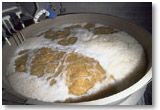
The maltster, during steeping, supplies the barley with the necessary amount of moisture required for germination. Usually, the moisture increase during steeping is around 45%. The water used must be biologically pure, or there will be mould formation during germination, giving the malt a musty odour. Steep water composition is not important, since the wetting process is caused by osmotic action, and only pure water passes through the aleurone layer.
Water of medium hardness with a pH of 7.5 is generally used. Temperature for steeping is about 10-13 degrees C (50-54 degrees F). The total steeping time is approximately 64 hours. After this period, the kernel is turgid, plump and softened. The water is drained off and the barley is ready for the second step.
The main object of germination is to affect the activation of the enzyme complexes; namely, diastase, peptase and cytase, and to obtain modification of the starch cells. During germination, the following changes happen:
1. Development of the rootlets and acrospire, or growing shoot, from the embryo of the kernel.2. Liberation or formation of diastase, cytase and peptase.
3. Modification of the starch cell walls of the endosperm.
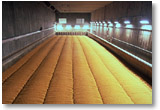
The grain is placed in large, long concrete troughs called "streets". Germination takes approximately six days at a temperature of 9-10 degrees C (48-50 degrees F). During germination, temperature, moisture and aeration are closely controlled, the important consideration to bear in mind being a slow, even acrospire development without allowing the shoot to break out of the seed coat, with gradual modification of the starch bearing cells. This will produce a high quality, high yielding malt.
The pneumatic malting system is highly favoured. In this method, moist air of a definite temperature is drawn through the germinating grains; therefore ensuring greater temperature and moisture uniformity and expulsion of carbon dioxide formed during germination. The grain is turned from time to time and sprinkled with water to maintain moisture requirements.
When the roots have grown to 1 1/2 times the length of the kernel and the acrospire, or growing shoot, from 3/4 to the full length of the kernel, the germination process has been completed. The protective layers of cells around the endosperm have been broken down and the enzyme complexes have only slightly modified the starch of the endosperm and the protein of the aleurone layer. The germinating grain is then moved to the kiln building where the third step in malt production occurs.
During kilning, the maltster will:
1. Arrest either temporarily or permanently, the growth of the germ.2. Dry the malt and thus render it capable of being stored for a considerable period of time without deterioration.
3. Impart colour and aroma to the malt.
To get a mellow malt, it is not only necessary to ensure modification of the starch cells, but it is equally important to dry the malt slowly and at low temperatures. The malt is subjected to temperatures which will arrest the growth of the germ. The kilning lasts from 24 to 42 hours, through a spread of temperatures from 27-82 degrees C (80-180 degrees F). The colour of the malt depends on certain glucoside compounds (melanoidins). These are formed at a temperature of about 60 degrees C (140 degrees F), the quantity depending on the moisture content of the malt when it reaches this temperature. These compounds then colour at a temperature of 82 degrees C (180 degrees F) or higher, colouring rapidly as the temperature rises above 93 degrees C (200 degrees F). Malt fresh from the kilns is cooled, then conveyed to the cleaning mills and elevators for storage.
Freshly cleaned malt causes mashing difficulties and it is usually stored for about 4 to 6 weeks before being used. During storage, precautions are taken to protect the malt from insect damage. The moisture content of the malt is monitored closely, as a high moisture content will present grinding difficulties in the brewery, and it may acquire a musty odour. The malting process is then complete.
The malt is dead as far as growth goes, but the enzyme complexes are only arrested in activity. The walls of the starch bearing cells of the endosperm have been broken down during malting and the malt is ready for shipment to the brewery.
Very simply then, malting unlocks the supply of starch in the barley kernel, making it available for the brewing process.
 Top |
HOME
Top |
HOME 